What we have learned replacing PRVs in garages, crawl spaces, wall boxes and yard boxes across Snohomish County and Whidbey Island
Location: Snohomish County and Whidbey Island, WA
Service: Pressure-reducing valves
Most pressure questions we hear come down to one valve: the pressure-reducing valve, or PRV, that steps the utility's pressure down before it reaches the fixtures. These are the questions customers ask us most about it, answered from the valves we have actually replaced. For reading your own pressure, start with our water pressure questions.
Do I need a pressure-reducing valve?
Only if your static pressure is above 80 psi, which is where the plumbing code requires one; below that it is optional. In July 2026 Chase and Willie could not find a PRV under a Freeland house that read about 70 psi, and it did not need one. Its weak water came from a meter valve left half open.
Washington's plumbing code requires an approved regulator, with a strainer ahead of it, wherever static pressure exceeds 80 psi, and the house brought down to 80 or less. In Freeland the gauge read 68 psi but fell to zero when a second hose bib opened, because the valve at the meter was only half open, probably since a water heater swap two months earlier. Opened fully, it gave the house 70 psi and its pressure back.
Can a failing PRV cause low water pressure?
Yes. A regulator can fail low as well as high, and when it does, the whole house goes weak at once. In March 2026 a north Harbour Pointe homeowner called because the pressure had dropped over two days. Logan and Willie replaced the failed PRV, and a hose bib on the same visit, and the house was back to normal.
When every fixture in the house drops together, the cause is usually upstream of all of them: the regulator, the main shutoff or the meter. If only one faucet is weak, the regulator is probably not the problem.
Can a bad PRV make my pipes bang?
It can. Water hammer is a pressure symptom, and a regulator that has stopped controlling pressure is one cause of it. In August 2026 Chase traced banging through an entire Harbour Pointe house to a failed PRV beside the crawl space entrance, swapped in a new one-inch valve and ran fixtures throughout the house with no more hammer.
Hammer also comes from fast-closing appliance valves and loose pipe straps, so we gauge the house before blaming the regulator. When the reading is high or swinging, the valve is the first suspect.
My PRV is dripping. Can it be repaired?
Usually it gets replaced rather than repaired. In July 2026 Logan and Willie found a regulator leaking in a Harbour Pointe crawl space, replaced it, set the new one to 60 psi and had the homeowner run several fixtures to be sure he was happy with the pressure before they left. A dripping PRV is worth a call that week.
A slow drip in a crawl space or basement ceiling does its damage out of sight, so close the main shutoff if it turns into a stream.
Can I ask for a lower or higher pressure setting?
Yes, up to the code limit of 80 psi. We usually set new valves between 60 and 70 psi, but the setting is your call. In October 2025 Connor and Logan set one in Mukilteo to 50 psi at the homeowner's request, and near Langley, Logan set one in a stand-up crawl space to 70 psi for the same reason.
Lower settings are gentler on fixtures, and higher ones keep an upstairs shower strong while other water is running. We set the valve, then have you open fixtures around the house before we leave, so the number matches how the house feels.
Where is my pressure-reducing valve?
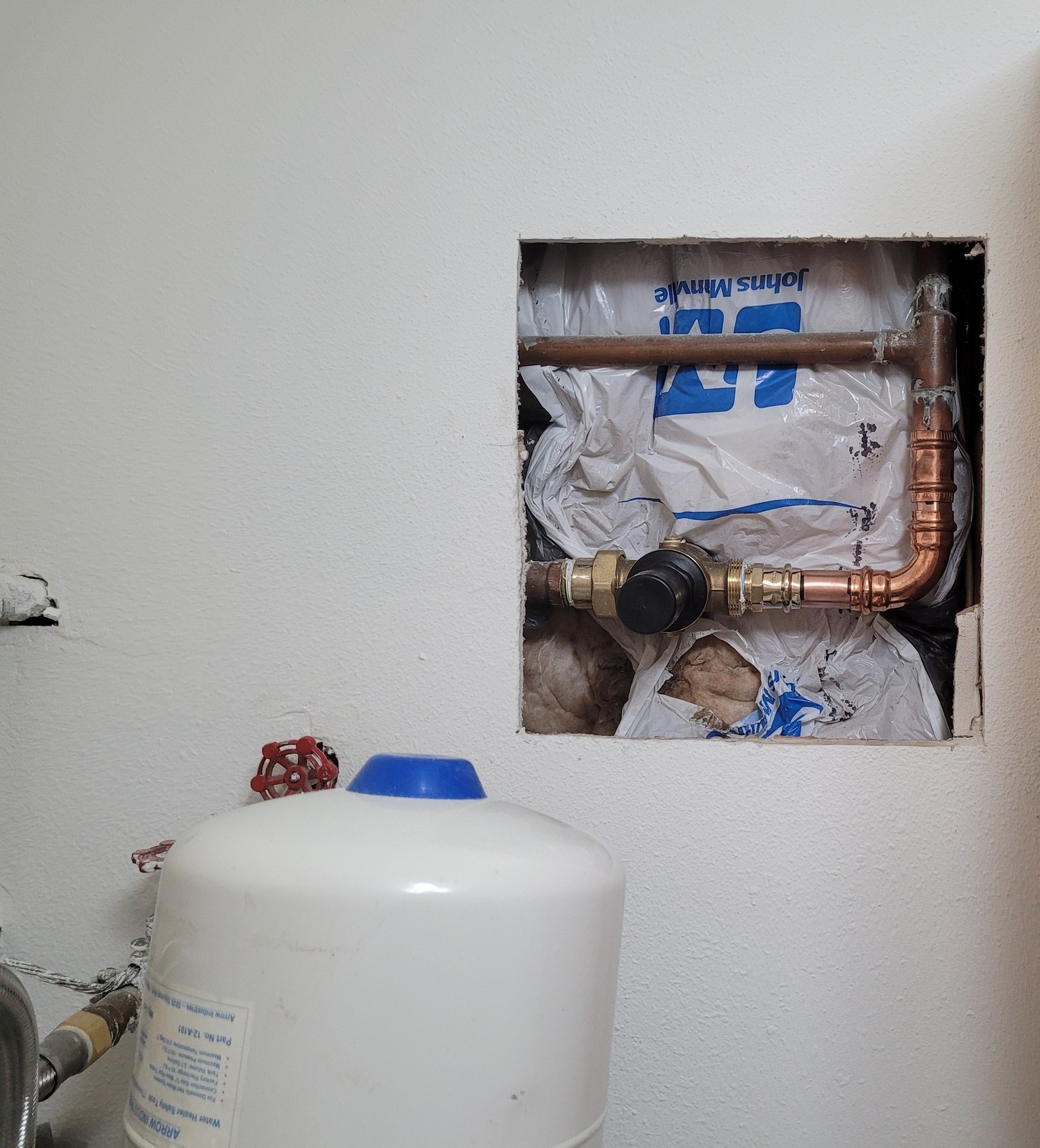
Usually just past the main shutoff where the water line enters the house: in the garage, the basement, a crawl space near its entrance or behind a wall panel. Some hide better. One Mukilteo regulator sits in a wall opening above the water heater, and one in Boulevard Bluffs was buried in an irrigation box in the yard.
If you cannot find yours, follow the main from where it enters the house, or call and we will find it on the same visit as the pressure check. Knowing where it is matters most on the day it starts to leak.
Can a pressure-reducing valve go on CPVC or other plastic pipe?
Yes, with the right adapters. In October 2026 Chase replaced a failed regulator at a house south of Snohomish whose supply line was CPVC, joining the new valve to it with a push-fit fitting, and brought the house from close to 100 psi down to 60 at the front hose bib.
Plastic supply lines are no reason to live with high pressure. The regulator itself is brass, and the adapters on each side are what change with the pipe.
Our Recommendation
Gauge the house before you replace anything, and find your regulator before you need it. If the reading is above 80 psi, or the valve is leaking or will not hold a setting, replace it and set it where you want it between 50 and 70. If the reading is steady and comfortably under 80, you may not need a regulator at all.
Not Sure What Yours Is Doing
We will gauge it, find it and tell you whether it needs replacing.
Call 425-374-3909 · Request a Quote
Related: water pressure testing and PRV replacement · water pressure regulators in Mukilteo · water pressure testing in Everett · a buried PRV in Boulevard Bluffs · water pressure questions for Snohomish County · thermal expansion tanks · water heater service
Stollwerck Plumbing & Sewer · Mukilteo, WA · WA License #STOLLPL780CJ · One-year guarantee