
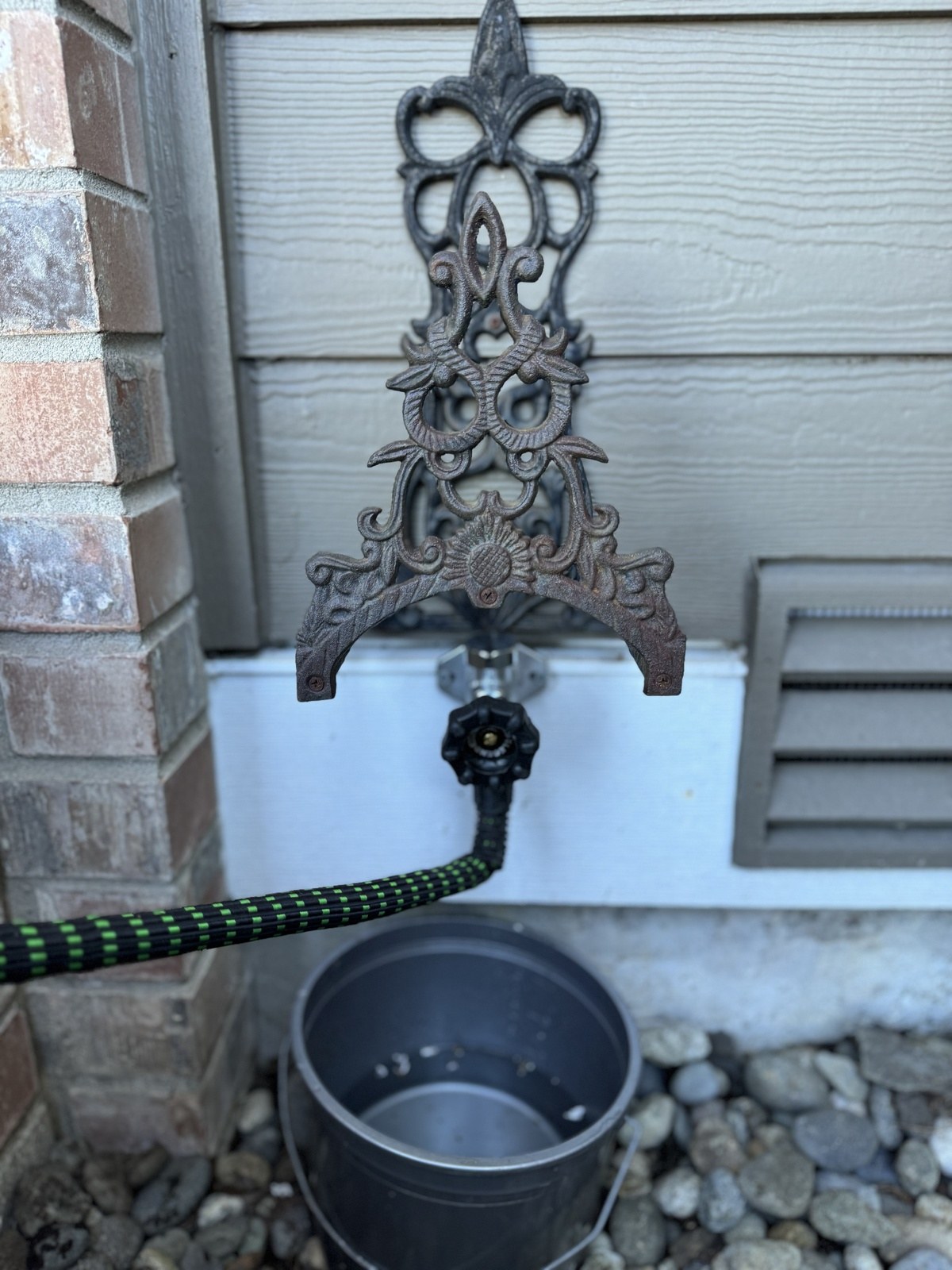
The five ways outdoor faucets fail here every summer — and why most of the damage happened last winter
Most of the leaking hose bibs we repair in Mukilteo each summer did not fail in summer. They failed quietly over winter, or wore out over years, and summer is simply when the hose goes back on and the truth comes out. Between June and August our crews are at Mukilteo hose bibs weekly — here are the five failures those calls actually turn out to be.
1. The freeze split that waits for the first hose connection
A standard hose bib that froze with water in it can split inside the wall and show nothing for months. Open it to rinse the deck in June and it may even seem fine — until a hose or sprayer is attached. Back-pressure then forces water out through the split, inside the wall, where you cannot see it. If your siding, garage ceiling or crawlspace shows moisture after the first watering weekend of the year, shut the bib off and call; that is not a washer problem.
2. The bib that no longer shuts off all the way
A worn seat washer lets a bib weep after it is closed — down the foundation, into the gravel, invisible. Last month’s example was a Harbour Pointe homeowner’s mystery water bill: meter quiet, crawlspace dry, toilets clean, and the answer was a front hose bib dripping where nobody walks. A drip too slow to notice is still fast enough to show up on a quarterly bill.
3. Leaks from the packing nut once irrigation season starts
A bib used twice a month survives on packing that a bib used twice a day will expose. In July, Logan and Willie repacked a Prier hot-and-cold hose bib on 107th Street SW that had started leaking from its packing nut under daily use — replaced the packing, turned it back on, tested it dry, done in one visit. This is the happy version of a hose bib call: caught at the packing stage, it is a repair, not a replacement.
4. The vacuum breaker that spits with a hose attached
The small dome or cap on top of a newer bib is its anti-siphon vacuum breaker — the part that keeps hose water from being pulled back into your drinking lines. When its internals wear, the bib sprays or dribbles from the top the moment a hose pressurizes it. It looks alarming and is usually the cheapest fix on this list, but it should not be removed or capped: it is doing protective work.
5. High house pressure, grinding every outdoor fixture down
Hose bibs are built for the same pressure range as everything else in the house, and Mukilteo homes are not all in that range — we have gauged houses here at 78, 79 and 95 psi. Above 80 psi, washers, packings and vacuum breakers all wear early, which is why some houses replace hose bibs twice as often as their neighbors. If outdoor fixtures keep dying young, gauge the house before buying the next one.
What replacement actually looks like here
Reaching a Mukilteo hose bib usually means going through something — a wall, a ceiling, or the crawlspace. On Marine View Drive in June, Chase replaced a failed eight-inch bib by working from the crawlspace via the garage: cut out the old fitting, pressed a coupling into the existing copper, set the new eight-inch Legend bib, then ran the hose until the line pushed out every air bubble and checked it all for leaks before putting the crawl insulation back. The same homeowner has a second bib queued up for the same treatment — same age, same duty, same wear.
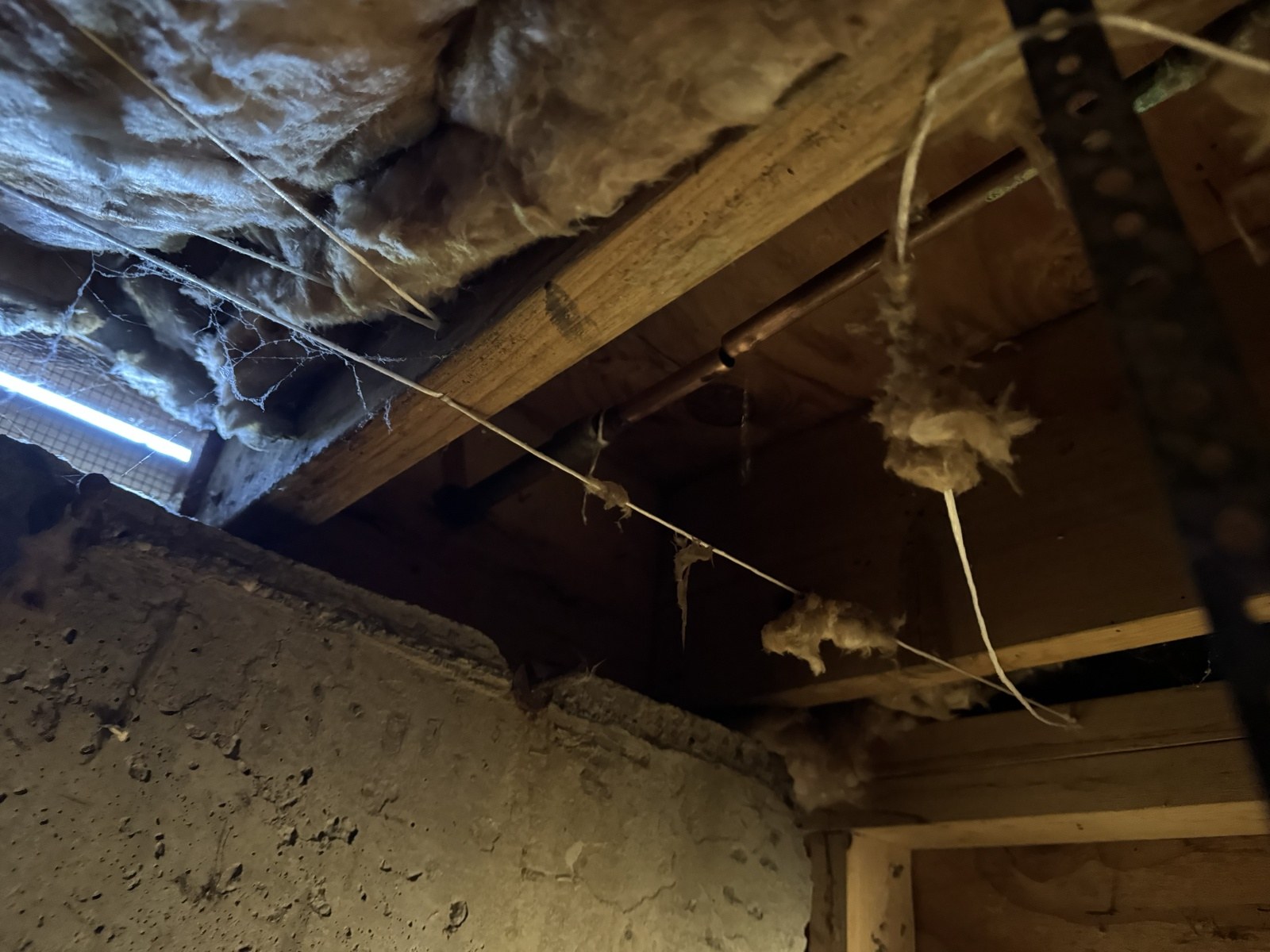
That pairing is typical. Hose bibs on one house are the same age and get the same weather, so they reach the end together. And not every call is a like-for-like swap: on Wilmington Way in June, Chase converted a cold-only bib to a hot-and-cold pair — warm water outside for washing dogs, cars and kids — and sealed the new penetration properly against the cedar siding.
The pattern that decides difficulty is the neighborhood. Harbour Pointe’s ’80s and ’90s houses mostly carry their original anti-siphon bibs, now thirty-plus years old and failing in batches; the repairs are routine but constant. Old Town’s older stock down by the ferry adds harder problems — galvanized stubs and odd fittings behind the wall — where the access is the job.
Our Recommendation
Repair when the failure is at the packing or the vacuum breaker — those are inexpensive, quick and worth doing. Replace when the bib weeps past a new washer, has frozen and split, or is a thirty-year-old original: put in a frost-free anti-siphon bib and stop having this conversation every summer. And every October, take the hoses off. A connected hose is what holds water in the bib through a freeze, and it is the single cheapest thing you can do to avoid item #1 on this list.
Why does my hose bib only leak when the hose is attached?
Because the hose creates back-pressure that finds the weak point. A vacuum breaker with worn internals spits from the cap, and a freeze-split body pushes water out through the crack — often inside the wall — only when the outlet is blocked by a hose or sprayer. Open-flow can look fine while either failure hides.
Why did my outdoor faucet start leaking the first time I used it this summer?
Almost always winter damage surfacing. Water trapped in the bib — usually because a hose stayed connected — froze, expanded and split the body or seat over winter. The damage sat dry and silent until the first summer use pressurized it. That is why the leak seems sudden when the cause is months old.
Is a slow outdoor drip actually worth fixing?
Yes, and the math is unforgiving. A bib that weeps after shutoff runs around the clock, soaks the area by the foundation, and adds up across a billing quarter — it is exactly how the Harbour Pointe water-bill mystery above happened. The repair is one of the least expensive we do; the drip is not.
A hose bib acting up this summer? We repair what can be repaired and replace what cannot — and we will tell you which is which before we start. Related: hose bib repair and installation · water pressure and PRVs · plumbing in Mukilteo · a hose bib install for a Mukilteo homeowner